Financial management

Back to City hall - Municipal administration

 
    See also  
  > Valuation  
  > Places where you can obtain information and pay your tax bills  
 
Home > Duties on transfers of immovables
  Printable version Printable version
Taxes
  > A simple, easy to understand account
> When to pay?
> Where and how to pay?
> Acts and by-laws
> Table of tax rates
> SDCs contributions
> Duties on transfers of immovables
> User fees: water and solid waste services
> Frequently asked questions
  > Municipal taxes
> Local improvement taxes
> Property Tax Sale
> Brochures
> Forms
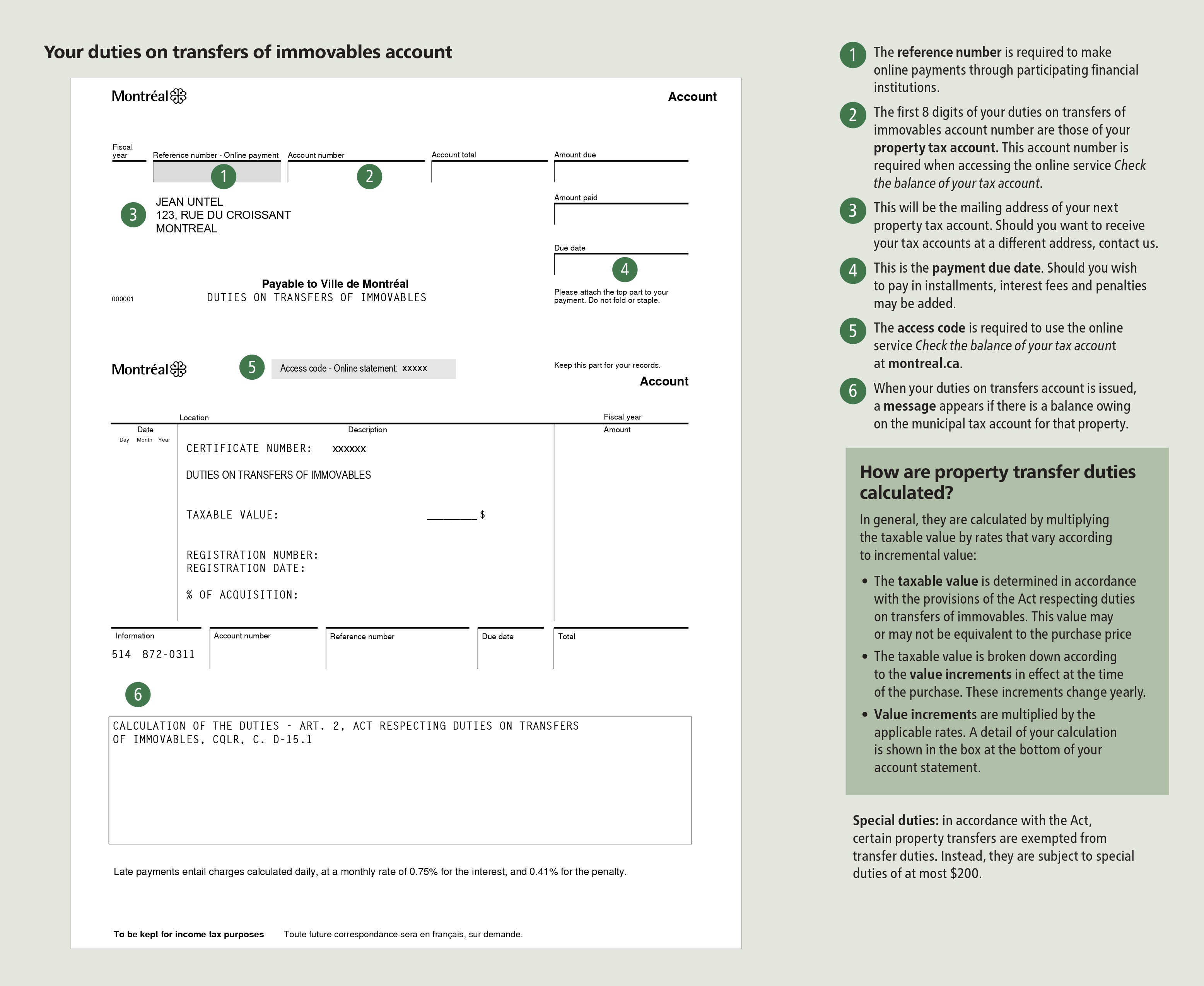
> Examples of tax bills

Duties on transfers of immovables

A transfer of immovables is a transfer of the right of ownership on a property as a result of a contract of sale, rental of more than 40 years, transfer of the rights of the emphyteutic lease or donation. Duties on transfers of immovables are charges that are payable when the right of ownership on a property is transferred. The buyer is responsible for paying these duties. Where there is more than one buyer, they are joint and severally liable for payment of the transfer duties. Every municipality must collect duties on the transfer of any immovable situated within its territory. (Act respecting duties on transfers of immovables – R.S.Q., chapter D-15.1).

The duties on transfers of immovables are imposed at the time of purchase of an immovable and are payable in one installment.

Value based

The value based corresponds to the greater of the following three amounts:

  • The amount that was actually paid for the transfer of the immovable (not including the GST and the QST)
  • The amount of the consideration1 stipulated for the transfer of the immovable (amount shown on the deed of sale)
  • The amount of the market value at the time of the transfer of the immovable (value of the roll multiplied by comparative factor of the fiscal year that corresponds to the registration date.

1 The following are generally regarded as considerations:

  • The value of any property listed in the notarized deed
  • The amount shown in the contract
  • Privileges, mortgages or other charges creating a claim against the immovable.

Comparison factor

Where the imposition is made on the basis of the market value at the time of the transfer, the value on the roll must be multiplied by the comparative factor of the fiscal year that corresponds to the registration date.

Formula

Value based = Value entered on the roll X comparison factor.

Comparison factors of the city of Montréal for fiscal 2007 to 2009 :

Fiscal

Comparison
factor

2009 1.11
2008 1.06
2007 1.00

The comparison factor is determined each year based on the median proportion that corresponds to the selling price of the properties for which a transaction has occurred over the year and their assessment entered on the roll. The comparison factor enables us to use a comparable basis for assessments from different rolls.

Computation of the duties on transfers of immovables

The duties on transfers of immovables is compute in relation to the value based, according to the following rates:

On that part of the value based

Rate

Which does not exceed $50,000

0,5%

Which is in excess of $50,000 but does not exceed $250,000

1,0%

Which exceeds $250,000

1,5%

Calculations using $330,000 as taxable value:

Multiply $50,000 by 0,5%

=

$250

Multiply $200,000 by 1,0%

=

$2,000

Then multiply $80,000 by 1,5%

=

$1,200

For a taxable value of $330,000 total fees will be


:


$3,450

Exemption

A buyer may be exempt from paying the duties on transfers in certain cases as set out in the Act respecting duties on transfers of immovables , R.S.Q., chapter D-15.1. The notary must write a note in the deed of sale (or deed of transfer) enabling the buyer to benefit from an exemption from paying the duties on transfers, in accordance with the legislation.

Main reasons justifying an exemption:

  • Transfer to an ascendant or descendant in the direct line (sale from father to son; from grandmother to granddaughter).
  • Transfer between spouses, whether they are married or civil union spouses, as defined by Act respecting duties on transfers of immovables . Same-sex spouses are included in this provision of the law.
  • Where the buyer is a public organization within the meaning of the law.
  • Where the transferor is a natural person and the transferee is a legal person with 90% of its issued shares with full voting rights are owned by the transferor.

Several other situations justifying exemption are provided for by law.

Special duties

Special duties are a form of compensation in lieu of transfer duties that are billed to buyers whose transaction is exempted.

The Act respecting duties on transfers of immovables – R.S.Q., chapter D-15.1), amended December 20, 1999, sets the amount of the special duties in accordance with the transferred values:

Value of the property

Amount payable

Immovable less than $5,000

No duties

Immovable of $5,000 to less than $40,000

Special duties equivalent to the transfer duties (0.5 %)

Immovable of $40,000 or more

$200


Since 2007, special duties are no longer applied to transfers between ascendants and descendants or between spouses (section 20 of an Act respecting duties on transfers of immovables, R.S.Q., c. D-15.1) when the transfer results from a death (City Council resolution CM06 0841 adopted December 11, 2006 ).


For more information, please:

  1. Call your borough office;
  2. Call the 311 (island of Montréal) ou 514 872-0311 (outside Montréal);
  3. Send us an e-mail.

The details contained here are for information only and have no legal value. The acts and by-laws posted on this site are for administrative purposes only, and although efforts are made to update them, they may not be the latest versions. Please check the sources before using the texts officially.


® All rights reserved, Ville de Montréal